Product Design
Digital and physical product experience.

I believe atoms and pixels contribute seamlessly to the human experience. A button is a button, whether it is molded in plastic or rendered on a screen. My job is to ensure the tactile promise of the physical world survives the transition to the digital one.
Product design is often treated as separate disciplines - Hardware vs Software. But users don't see it that way. They see one Brand, one Experience, and one Frustration when it breaks.
This frustration often comes from the "Invisible Parameter" - the gap between what users expect (based on their mental models) and what we build. I believe Innovation is an act of balancing the cost of friction against the promise of reward. We have to guide a brain wired for efficiency to see that the unknown is worth the energy.
I craft products with one rule: Meaningful Innovation.
I love exploring the new, but just because we can put a massive screen on a fridge doesn't mean we should. A feature must earn its place by solving a real problem; otherwise, it is just expensive decoration. My job is to ensure technology amplifies the product, rather than distracting from it.
Physical

The discipline of atoms.
Physical design is constrained by physics, economics, and logistics. Unlike software, there is no "Undo" button after tooling is cut. Every millimeter impacts the Cost of Goods Sold (COGS), and every material choice communicates value.
The challenge here is manufacturability. It requires a deep understanding of ergonomics (how bodies fit), CMF (Color, Material, Finish), and the mechanical realities of the assembly line. It’s not just about how it looks, but how it feels, weighs, and ages.
The user interface can be mechanical (e.g. valves and handles), analogue (e.g. switches and dials) or electronic (e.g. capacitive and microcontroller) and is usually made of several stationary components.
Fun fact: you work a lot more with millimeters than pixels.
Digital

The discipline of pixels.
Digital design requires no physical inventory, which makes it prone to a different burden: unrestrained complexity. Without the hard constraints of atoms, digital products can easily become bloated with features that don't solve problems.
Great digital design acts as a filter. It imposes artificial constraints to create focus, accessibility, and speed. It relies on Information Architecture to guide navigation, and visual hierarchies to manage cognitive load. The goal is to make the complex logic of the backend feel invisible to the user.
The user interface is mainly software development mostly influencing the front-end and GUI.
Fun fact: the colour you defined has a high chance to be seen as a different hex value.
Hybrid
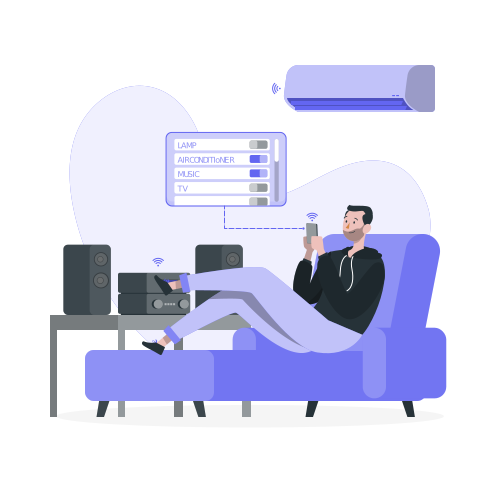
The Synchronized Experience.
This is the most volatile and rewarding space. Scaling a hybrid product requires synchronizing two incompatible rhythms: the slow, waterfall reliability of Hardware and the fast, agile iteration of Software.
It manifests in different levels of integration. It can be embedded, like a car's touchscreen controlling the air conditioning, or separated, like a mobile app controlling your smart lights. In both cases, the goal is a unified experience. The user shouldn't feel the gap where the sensor ends and the app begins. When this synchronization fails, the product feels broken, regardless of how good the individual parts are.